

BEST FRIENDS FOREVER, A Story of Ruth
YA Manuscript and Illustrations by Jan Lis
PREFACE
As I read the ancient Bible story of Ruth, I was captured by the drama. This Old Testament book is the ultimate love story. I found all the love, mystery, and intrigue you expect from a great movie. The plot is a riches to rags to riches story, with the fate of the world hanging in the balance. As I read the story, many ancient customs seemed strange to me. I wanted to make sense of them. So began a wonderful journey searching for answers to my questions.
BEST FRIENDS FOREVER, A Story of Ruth, is told by Ruth herself. The story takes us back in time to ancient Israel. For Ruth and Naomi, Ruth’s mother-in-law, life looks hopeless. Their husbands have died. Naomi’s sons have died. With no children, they have no future. Poverty is all life seems to offer them.
But God has a plan for Ruth. Come with me and discover how the love of family, and the abiding love of God shine brightly through a seemingly impossible situation.
Jan Lis
Chapter One
Meeting Ruth
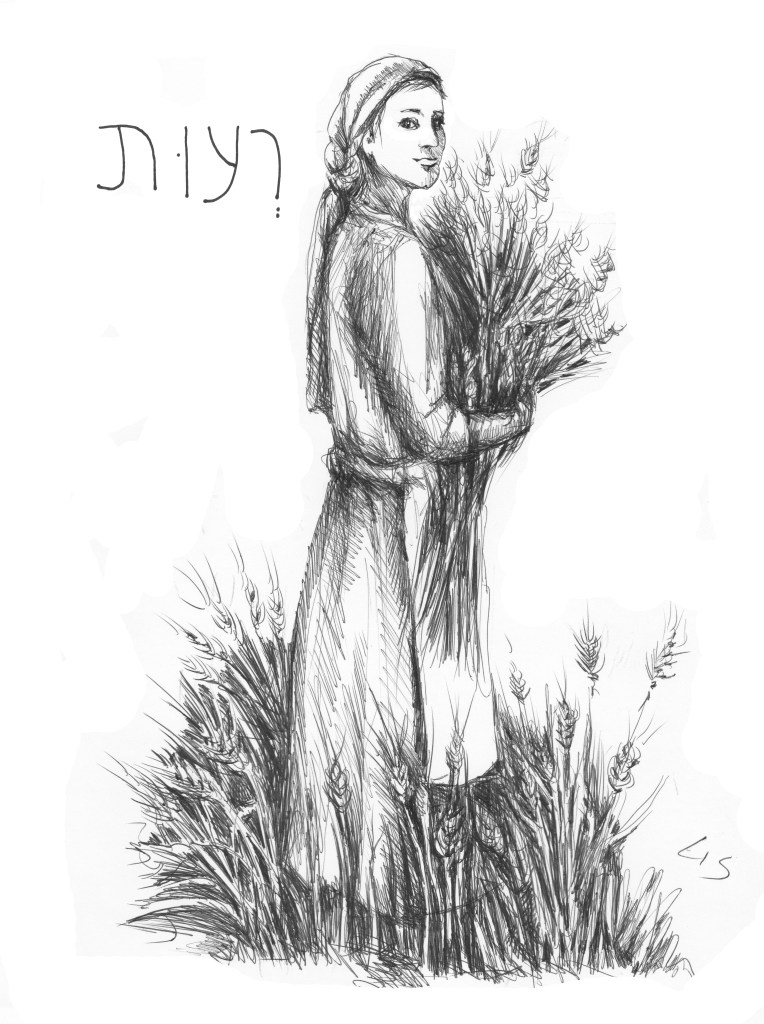
My name is Ruth. Welcome to my story. Do you mind if I ask you a question? It’s about best friends and friendship. Who doesn’t love the fun of having a best friend? Someone to hang out with, share secrets, and be silly with. All good stuff right, but what happens when your friend’s life changes? When things at home go wrong. When your best friend’s father or brother dies, and the money just isn’t there anymore. Your friend can’t buy the latest ‘must have’ and wears tacky, thrift shop clothes. Then she moves out of her ‘good’ neighborhood. Is she still your best friend forever?
Do you think a friend is being pals with someone when the sun is shining, and also when it starts raining junk all over? My story is about a friendship like this. Let me tell you about sticking it out with my best friend, who just happened to be my mother-in-law, Naomi.
Are you up for a little Time Travel back to my life? Which began about four thousand years ago, in the country of Israel, in a town called Bethlehem. Yes, that little town of Bethlehem we sing about at Christmas. The town where Jesus was born, and placed in a manger that night the star shown in the east. But my particular story takes place much earlier than that. In fact thousands of years before.
It was a time before there was a king in Israel. Judges ruled over the land, and things were pretty messed up in Judah. (Another name for Israel.) People didn’t do the right things by each other, and there was fighting all the time.
But in the little town of Bethlehem, where my future mother-in-law lived, things were different. Sheep roamed the hillsides. Barley and wheat grew in the fields. There was peace in the land because the people there loved God and listened to Him. But things were about to change.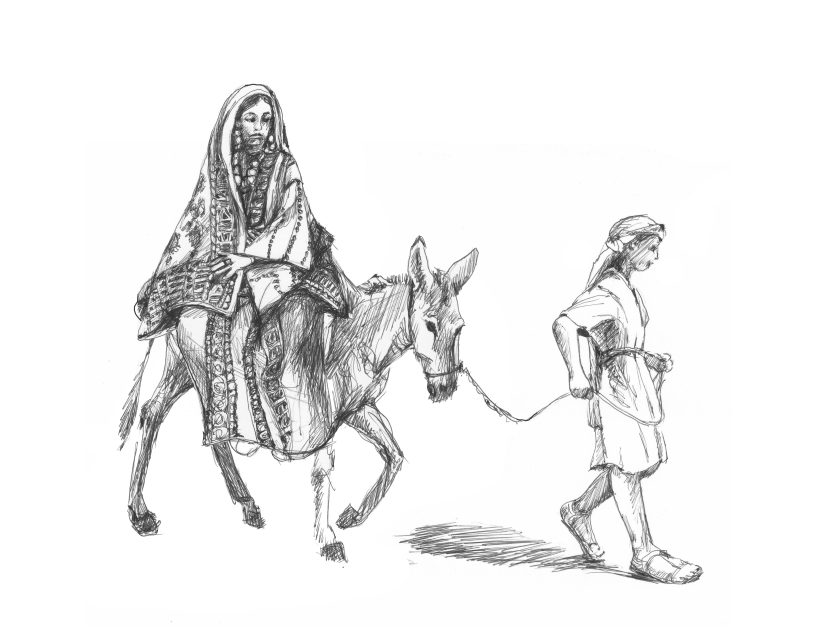
Chapter Two
A Famine in Israel
Our story opens with a disaster. There was a famine in the land of Judah. A huge crop failure occurred. Who knows the reason? Perhaps it was a cloud of locusts that swept in like one of the plagues of Egypt and ate up all the grain. Or a lack of rain caused the tender young plants to wither and die of thirst. At any rate, there was no grain to harvest. There was nothing to be ground into flour. And no flour meant no warm bread to take from the oven. It’s funny that in Bethlehem, which means House of Bread, there were precious few loaves to eat.
My mother-in-law, Naomi, was married into a rich, influential family. Her husband’s name was Elimelech. He was a wealthy landowner. Elimelech and Naomi had two sons, Mahlon, who would become my husband, and his younger brother, Kilion. Names were a little different back then.
Because of the really serious food shortage, Elimelech decided to take Naomi and the boys to the neighboring country of Moab to live. Judah and Moab were traditional enemies, but at the time of my story, the two countries were dwelling peacefully beside each other. I am from Moab, so I can say the people there were into idol worship, and other stuff the God of Israel detested.
So, Naomi and her family packed up all their belongings. I can imagine donkeys and camels piled high with baggage. Carts loaded with furniture, rugs, and utensils are almost overflowing. Naomi in her finest, is seated grandly upon a donkey. A servant walks beside her with a gaily-colored umbrella to shade her from the sun. Such a sight. Neighbors and friends line the roadway. As the long caravan starts, they wave goodbye with tears in their eyes.
Chapter Three
Marrying Moabite Women
Elimelech owned some land in Moab. But when the family reached their destination no dear friends were waiting there to greet them. No happy embraces. No warm dinner to cheer their hearts, or freshly made beds to rest their weary heads. They were strangers in a strange land with stranger customs.
Imagine being in a new country with different customs. You are not familiar with the language. Even the food is not ‘your’ food, not what you were used to back home. Where everyone dresses funny and looks at you as if you were weird. How do you make friends? This was a difficult time for Naomi. Remembering the happy days she left behind in Bethlehem, Naomi began making a new life for her family in Moab.
But Naomi’s trials were not over. Another devastation befell her family. Elimelech, her husband and father of her boys, Mahlon and Kilion died. Can you imagine, Naomi was now a widow in a foreign land with two boys to raise, and no work experience? At this time, when a husband died, there was no other means of support. If family was around, they would help out, but Naomi’s relatives were back in Judah.
Women back then were not free to go out and get a job. Their lives were greatly regulated as to what they could and could not do. The husband was the head of the house, and the wife was totally dependent on him for all the wants and needs of the family. Naomi was now in a tough spot. She had two sons to raise, and could not go out and earn a living.
Elimelech had left a little money. There was enough to live on for a while. Then perhaps Naomi started selling her beautiful gold earrings, bracelets, and necklaces, a few at a time. This kept a roof over their heads and food on the table. It was a time of hardship, and Naomi had to scrimp and save. They were certainly not living well, as a matter of fact, they were poor. But Naomi managed and they survived.
The boys grew into young men and started looking around at the pretty Moabite girls of marrying age. This was a big no, no. Young Jewish boys were forbidden to marry foreign women no matter how beautiful they were. Foreign wives might lead their husbands away from the Lord of Israel, and into idol worship. But this did not bother Naomi’s sons. That they were in Moab, not Israel was their thinking.
So, each son took a Moabite bride home to Mama. This is where I enter the story. Do you know Ruth means ‘friend’? When I first saw Mahlon, I fell in love. He was the oldest son with dark hair and lovely eyes. We were married, and I came to live in this Jewish family. Shortly after, Naomi’s second son, Kilion married another Moabite girl named Orpah.
Our husbands were able to find jobs working in the fields. And for a while life was good. But Naomi now had two daughters-in-law under her roof who knew not the God of Israel that she worshiped. She was a wonderful second mother to Orpah and me. She taught us the ways of a Jewish household. Most importantly, Naomi introduced us to her God.
Ten wonderful years passed living in Moab. Then Naomi, Orpah, and I were burdened with yet another disaster. Both of Naomi’s sons, our husbands, died. We aren’t told how. Perhaps there was an accident harvesting the grain. But Orpah and I were now left without husbands. This was the tragedy of tragedies for Naomi. No husband, no sons to carry on the family name. No male heir to inherit the family land in Judah. This is the way customs were in ancient days. Ownership of property in Israel went from the father to the oldest son. And now there was no son. Naomi was indeed brought low.
But God has a plan. He always has a remnant. From the Garden of Eden, the enemy of our soul has tried to destroy the line our Savior would come through. Yet we see the crimson thread continue down through history. And Elimelech’s line will be no different.
Upon hearing that the Lord had favored Israel and there was food again in the land, Naomi prepared to return to Judah with her two daughters-in-law, Orpah and Ruth.
Chapter Four
I Will Go With You
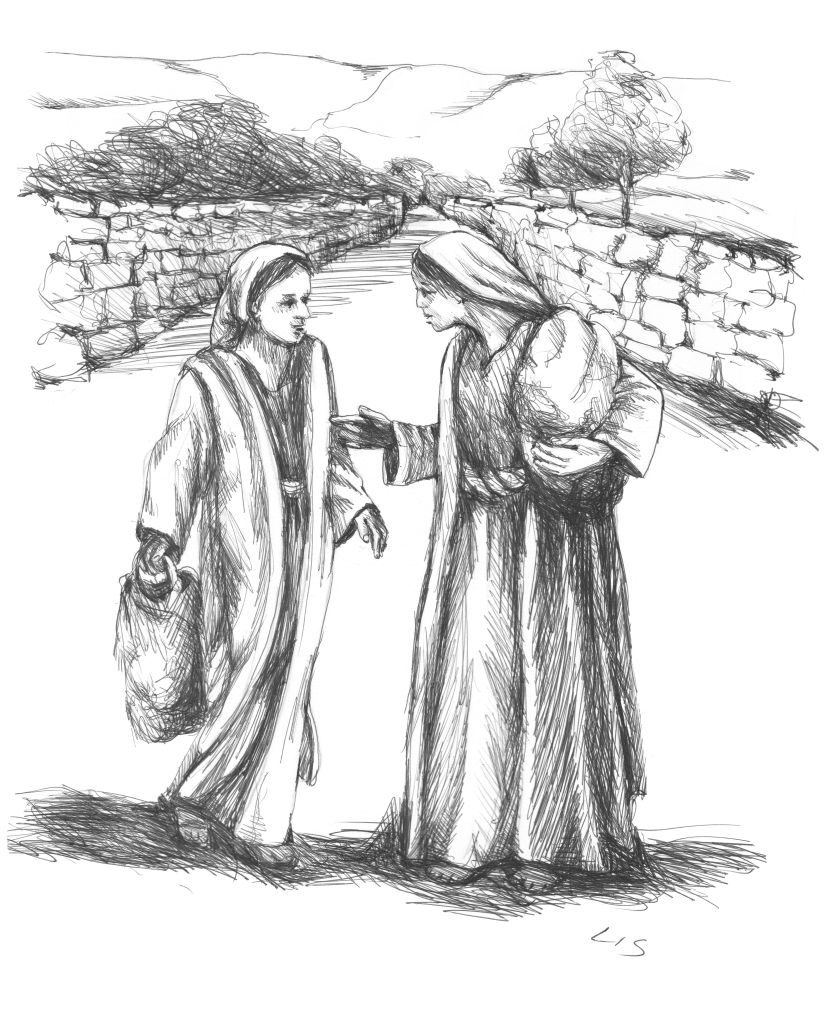
Eventually, news came to Naomi that the famine in Israel was over. So, she decided to return to the place of her birth, to her family and friends in Bethlehem. There was nothing left for Naomi in Moab. She would take her daughters-in-law with her. It was easy to prepare for the journey home. Naomi, Orpah, and I bundled what few possessions we could carry. And we set off on the dusty road leading back to Judah.
Naomi told us about the life Orpah and I would lead with her in Bethlehem. A life of poverty was our fate because we had no husbands or sons and therefore no place in the land. In Israel, we would not be free to marry outside of the family of her dead husband, Elimelech. That was the law in those days. And we would face possible rejection because we were foreign women from the despised country of Moab.
As we walked the dusty path to Bethlehem, Naomi stopped and turned to Orpah and me. With tears in her eyes she said,
“My dear ones, you must go back. May the Lord show kindness to you as you have shown to my sons and to me. May He also give you husbands and homes to rest in.” Then she kissed us and we wept. But Orpah and I refused to leave Naomi, insisting that we would go with her to her own people.
“No, return home my daughters. Why do you want to come with me? Am I going to have more sons for you to marry? I am too old for that. Even if I could, would you wait until they were grown to marry them?” Naomi protested. Remember we had to marry men within the family of Elimelech.
“It is worse for me my daughters than for you. Because the Lord is against me.” Naomi felt because of all that had happened to her, God had turned His back on her. She saw nothing ahead but a life of destitution, with no future waiting for her. We hugged each other with tears falling from their eyes.
Orpah and I had a choice to make. Would we go with Naomi to an unknown life, or stay where we were? Where we had always lived and felt comfortable. Both Orpah and I seemed the same. We were similar on the outside. But inside, in our hearts we each had a decision to make. What would we choose? The Lord knew what was on each of our hearts. He knew who had earthly pleasures on her mind. And who would follow Him with all her heart?
Then Orpah kissed Naomi and turned from her. She would go back. She would stay in Moab with her old life. Naomi sadly watched her leave, then turned to me and said,
“Look your sister is going back to her people and her gods. Why don’t you go with her?”
“Please don’t make me go back. I don’t want to leave you. Where you go, I will go. Where you stay, I will stay. Your people will be my people, and your God my God,” I said looking pleadingly at Naomi.
And your God will be my God. I had sat at the feet of Naomi, learning from her of the Lord, the One True God. Naomi’s gentle, loving ways and sweet spirit made an unforgettable impression on this young Moabite girl. “I want what Naomi has,” my heart cried. The peace that came from trusting in the God of Israel.
“Where you die, I will die and be buried there. Let nothing but death separate us.” That was my profession of undying friendship. I would remain with Naomi no matter what, even to death. I was all in. A life of hardship and loneliness in Judah, without a husband and children was not appealing to me, but I was going with my friend. Unconditional love, so symbolic of Jesus’ love for us.
I pledged not to leave Naomi even with the threat of uncertain times before us. When Naomi realized that I would not change my mind she gave up trying to convince me to stay in Moab.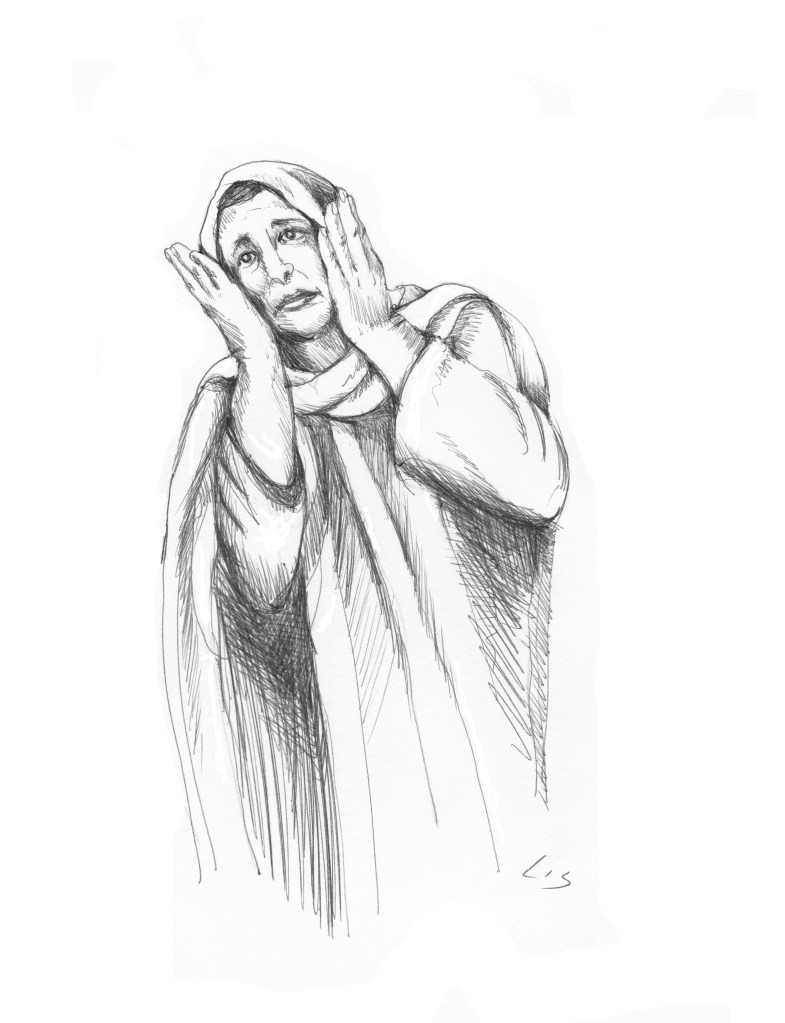
Chapter Five
Call Me Bitter
Naomi and I traveled on until we came to Bethlehem. In a flurry of excitement, the townspeople rushed out to meet us. They stopped, looking questioningly at the two women walking along the dusty road. We were dressed in the rags of poor peasants, carrying our belongings in bundles.
“Can this really be Naomi?” they asked. “She left proudly riding on a donkey, decked out in her finest. Now she returns to us with feet covered in dust and dressed in rags.”
“Don’t call me Naomi (pleasant), call me Mara (bitter). God has made my life bitter. I went away full. But the Lord has brought me back empty. He has afflicted me, and has brought misfortune on me.” Naomi said to her friends of old. When Naomi left the town of Bethlehem, she had a husband and sons, with wealth and position.
The loss of her husband and two sons, the probability of no grandsons, and no descendants was hard enough to face. But the thought that the Lord was displeased with her was heartbreaking. Naomi had gone through so much. Now she was returning in shame certain the Lord had dealt bitterly with her.
Naomi must have felt she was to blame for all that had gone wrong. And she was convinced that God was blaming her too. But what she had yet to realize was that God was her best friend. He loved Naomi with a love that never quits. He knew her character and inner strength. Look what she had already accomplished. Alone in a strange land, raising two boys on her own. Naomi would come through this difficult time ahead just fine. And the Lord was about to bless her for trusting Him, more than she had ever dreamed.
Chapter Six
Gleaning in the Field
Naomi and I arrived in Bethlehem at the beginning of the barley harvest. Ripened barley was the first grain of the year to be harvested. Sown in the winter months the barley crop ripened in the early spring, in March or April. The beginning of the barley harvest was celebrated by the feast of Firstfruits. A sheaf of barley was brought into the Temple for the priest to wave before the Lord. The sheaf of barley represented bringing the entire harvest before the Lord for His blessing. The Israelites could not eat any of the new grain harvest until after it had been presented to the Lord.
We found an empty one-room cottage to live in over on the edge of town. And we set to work getting it into proper shape. We dusted the earthen floor, repaired the fireplace, mended the broken table leg, and put new seats on the two chairs. Finally, the little hut was livable, but what were we going to do for food? That old law again about women not going out to work.
But there is another excellent law in the Old Testament called the Law of Gleaning (Gathering). God commanded the Israelites to show kindness to the less fortunate who might be living with them – specifically the widows, orphans, and strangers. The law said that anyone who was harvesting his field was to leave the edges of the field for the poor. Rather a fine idea and one that I intended to make use of.
Bright and early the next morning I said to Naomi,
“Let me go into the fields where the workers are harvesting. Maybe I will find favor in their eyes, and be allowed to glean (gather up) whatever grain is left behind.” This idea seemed good to Naomi, so she said I could go. I always tried hard to be respectful to Naomi, and obey all she said.
So, I went into the field where the barley was being harvested. As it turns out Naomi had a relative from her dead husband’s side of the family. A wealthy landowner named Boaz. I just happened to go into the field belonging to relative Boaz to gather the leftover grain. Just happened? I just happened to go into Boaz’s field. Not hardly. As we will see, God had a plan for Boaz and me. It was by His leading I ‘happened’ into the field of Boaz.
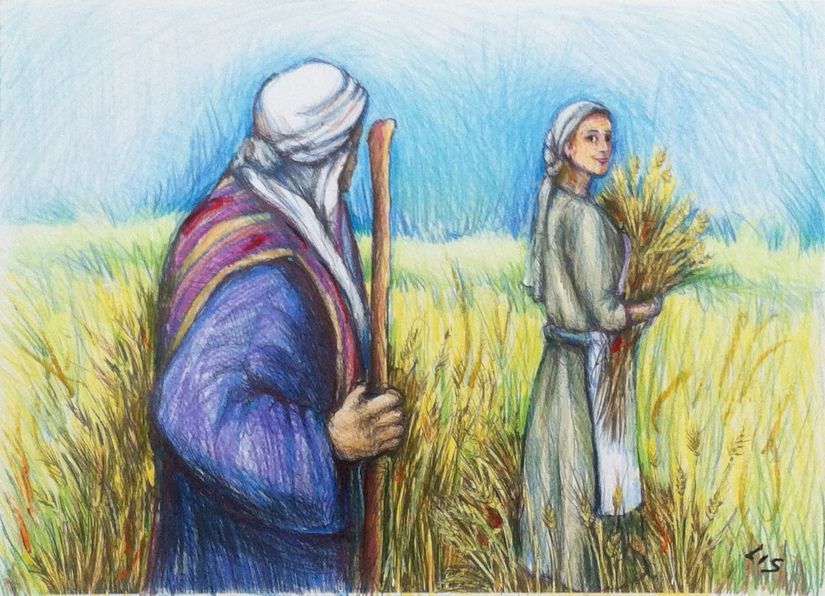
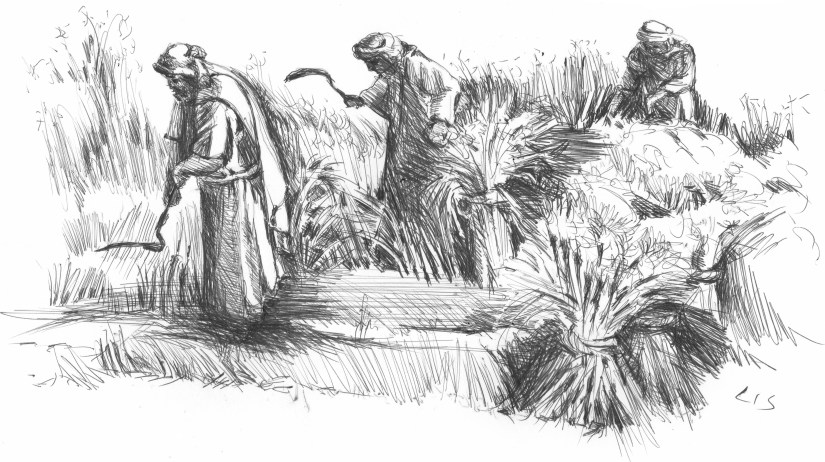
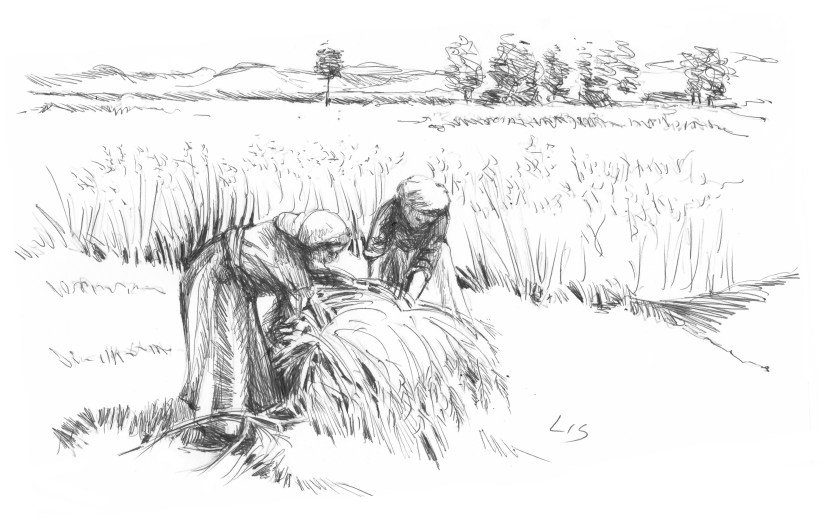
Boaz, which means strength, arrived at his barley field and looked over the ripened grain. He saw his men swinging their scythes, cutting the stalks of barley. He saw his maidservants coming behind the men tying the stalks into bundles. Then with interest, his eyes rested on me. He asked his foreman,
“Who is this young woman?”
“She is the Moabite woman who returned with Naomi. She has asked, ‘Let me gather up the leftover sheaves of barley behind the workers.’ And has been at work all day, hardly taking time to rest,” the foreman replied.
My prayer has been to glean in the field of someone in whose eyes I find favor. First, I find favor in the foreman’s eye. Secondly, as we are about to see, I find favor in the eyes of Boaz.
Boaz nodded and strode into the field to where I was working. He stood quietly observing me as I gathered the barley into my apron. I looked up from my work and Boaz quietly said,
“Listen to me, my daughter. Don’t go to glean in any other field. Follow along after my men and servant girls. I have told the men not to harm you. And when you are thirsty, drink from the water jars.”
Boaz was kind. Though older than me, he was tall and muscular with just a hint of grey at his temples. He jumped at the chance to be my protector by telling his workers that this Moabite woman was allowed to glean in his field and come to no harm. I was free to drink from the water jars. He called me his daughter, but then he was older than I
“Why have I found such favor in your sight that you would notice me, a foreigner?” I said bowing to him. When exactly what I have asked for happened, “May I find favor in the sight of someone.” I respond, “Why?” Does that sound familiar? How many times do we pray for something, and then are surprised when God answers our prayer?
Boaz was aware of me since my arrival with Naomi. He revealed, “I have been told all about you. How you have cared for Naomi. How you have left your parents and homeland to follow your mother-in-law.” Boaz observed us in our state of poverty and we found favor in his eyes. Boaz befriended Naomi and me when we were sorely in need of a true friend.
“May the Lord repay you for the good you have done for Naomi and her family. May you be richly rewarded by the God of Israel, under whose wings you have come to take refuge,” Boaz continued. To take refuge. What a beautiful picture. Like a mother hen gathering her chicks around her. Sheltering them with her outstretched wings. God wrapping His arms around us. Holding us close to Him in loving protection.
I was humbled by Boaz’s kindness and said, “May I continue to find favor in your eyes. You have given me comfort and spoken kindly to me even though I am not one of your servant girls.”
So, I worked steadily throughout the day, only stopping occasionally for a sip of water. At mealtime, all the workers came in from the field to rest and eat. Boaz looked up and noticed me still gathering in the field. He sent a servant out to invite me to come and dine with him and his harvesters. I had not eaten since early that morning, so I gratefully accepted. When I sat down Boaz offered me some bread dipped in wine vinegar and some roasted grain. I ate until I was full and had enough left over to wrap up and take home to Naomi.
After the restful meal, I returned to the field to finish gleaning. Boaz gave orders to his men to let me glean even where I would not ordinarily be allowed to. And not to fuss at me for doing so. The men even pulled some stalks of barley out of the bundles and dropped them on the ground for me to pick up. They thought I didn’t notice this special kindness.
Boaz is a man of great strength of character. He is a caring man of authority who chose to take me under his wing and make sure I was provided for. He was concerned for my safety and well-being. He invited me to eat at his table, making room for me in his life. Finally, he asked me to continue gleaning in the fields until both the barley and wheat harvests were over in mid-June. I think Boaz’s heart was becoming tender toward me, a young Moabite woman.
Chapter Seven
Raising Up Sons for the Dead
I worked in the field until evening. Then I threshed the stalks of barley I had collected by beating them against a rock to release the grain. Finally, I winnowed the grain by tossing it into the air to remove the lighter inedible outer husk. When I was done, I returned home and gave Naomi the barley I harvested, and the leftover food from lunch. Looking at the bounty,
“Blessed be the man who took notice of you today.” Naomi said. She saw I had certainly found favor in the eyes of someone, and with great curiosity, she asked where I had gleaned.
I excitedly told Naomi about the handsome, older man whose field I had been working in all day.
“His name is Boaz,” I added.
“Boaz?” replied Naomi eagerly. “Well bless him for remembering to show kindness to us, and those who have passed away.” And she said, “Boaz is kin from my dead husband, Elimelech’s, side of the family.”
You could feel Naomi’s excitement as she realized I had come under the protection of a close relative.
“He is our relative, one of our kinsman-redeemers.” Now, the kinsman-redeemer plays a very important part as the rest of my story unfolds. So, the term needs some explanation.
A kinsmen-redeemer is a male relative able to redeem or rescue something that would be lost. In this case, it is necessary to have heirs to continue Elimelech’s family name so that his future generations would have a place in the land. Carrying on the family name and owning property in Israel was very important to the Jewish people.
Simply stated this law says: If a man dies without a son, his widow must not marry outside the family. Her husband’s nearest male relative is to marry her. Their first-born son is to be raised up as the son of the dead husband to preserve his name in Israel. It was necessary for the name of Elimelech to be redeemed so that his heirs would continue in Israel’s genealogy, and that future generations would have a place in the land.
This is why Naomi has been so upset, thinking the Lord had turned against her. All has seemed lost up to this point. With the death of Naomi’s husband and sons, it seems the family name will die out with their deaths. When Boaz entered the picture, the prospect of marriage and raising up a son for Mahlon, my dead husband, became a reality. Maybe Naomi has not returned empty after all.
Naomi cautioned me to stay with the women in Boaz’s field because I might not be so safe in the field of another. So, I obeyed Nomi and continued to glean until the middle of June when the wheat harvest was completed. After the grain was harvested, it was taken to the threshing floor, and the process of removing the grain from the stalks began.
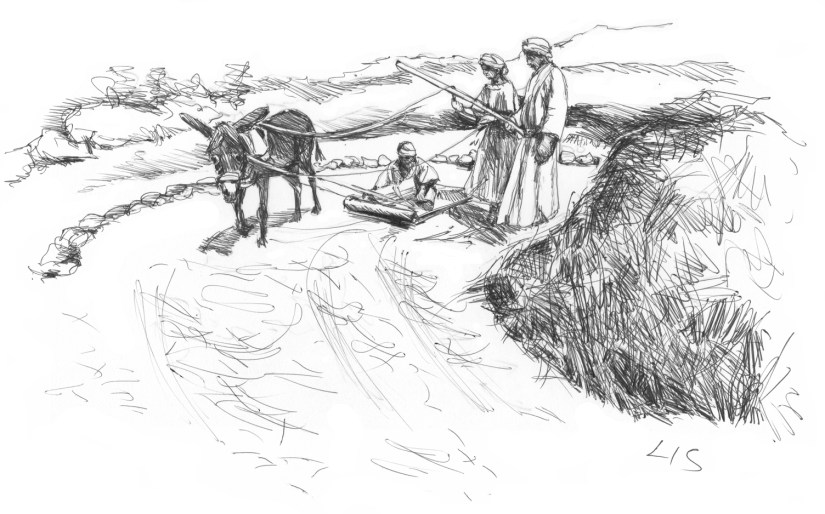
The threshing floor was a big flat stone or flat packed earth area where the stalks of grain were placed. A sledge (a flat wooden pallet with stones embedded in the bottom) pulled by oxen or donkeys over the stalks, separated the grain from the straw. Heavy stones weighted down the top of the sledge. Sometimes the farmer and his children weighed the sledge by sitting on it.
The threshing floor was located on top of a hill. A strong wind was necessary for the next part of the process called winnowing. This step separated the grain from the chaff. The chaff is the protective part of the husk surrounding the kernel of grain. The grain was tossed into the air by big wooden forks. Gusts of wind from the hilltop carried away the lighter chaff, leaving the heavier grain to fall to the ground.
Winnowing usually occurred in the late afternoon when the evening winds picked up, and lasted well into the night. This process had a festive air to it as the workmen celebrated the competition of the spring and summer harvests. Too tired to return to their homes, the men usually spent the night sleeping on the straw on the threshing floor.
Chapter Eight
Naomi’s Request
Naomi and I settled into life in Bethlehem. We lived quietly in our tiny cottage on the edge of town. By now we had quite a few clay jars filled with grain. And the aroma of bread baking at our hearth filled the hut.
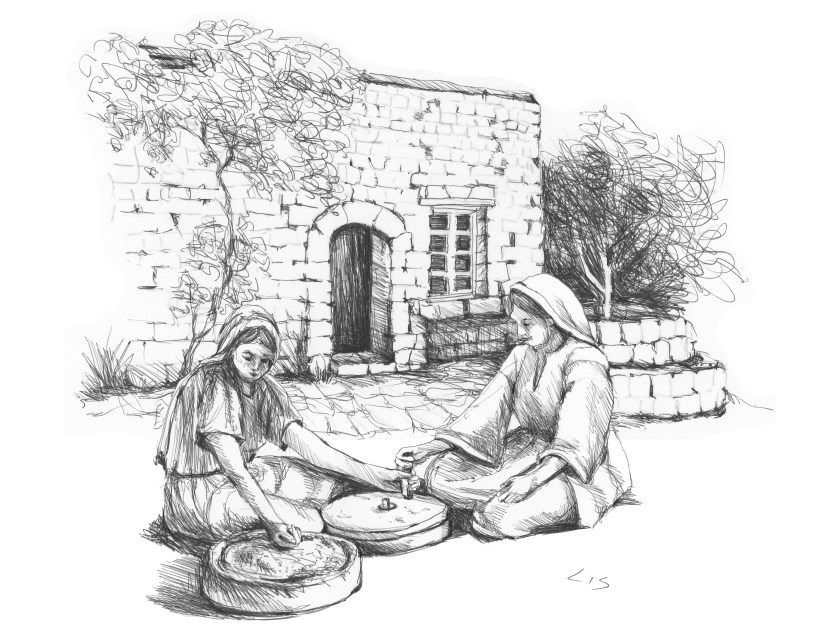
One day we were sitting outside the front door grinding grain into flour. Naomi had been mulling over something all through the harvest season. She leaned close to me and said,
“My daughter, should I not try and find a home for you? A home where you will be well provided for. Is not Boaz in whose field you have followed the harvesters, not a kinsman of ours?”
Naomi still desired marriage for me. Now she felt she could do something about it. She saw Boaz and me working together day after day. Sharing our meals, laughing, and becoming friends. She saw how Boaz took steps to protect me. Plus, he is a relative with the power to redeem the family name. And Naomi is about to go into action. Mama has a plan!
What Naomi told me to do next was quite perplexing. It doesn’t seem like a very good piece of advice to come from your mother-in-law. We must remember that we have zoomed back to my time. And what seems strange today was quite ordinary then. Customs were a lot different then than they are now. That said, let us look at what Naomi advised me to do.
Naomi had learned that Boaz would be at the threshing floor winnowing grain that evening. She told me to wash and perfume myself and put on my best clothes. Then she said,
“Go to the threshing floor, but don’t let Boaz know you are there until he has finished eating and drinking. When he lies down remember where he is. When it is dark go to him. Crawl under the covers at his feet and lie down. He will tell you what to do.”
Wait a minute? I’m a kind, loving woman of virtue. Doesn’t virtue mean a woman of high moral character? That’s one word that still means the same today.
So, how did I reply to my mother-in-law’s strange request? Are you ready for this? I simply answered,
“I’ll do whatever you say.” This is friendship and obedience to the max. Now let’s see if I get myself into a jam.
That evening, I went to the threshing floor and hid behind a bush so I would not be seen. I watched Boaz and the men. Their work done for the day they reclined on the ground eating and drinking.
Boaz was in good spirits as he went to make up his bed on the straw piled up at the far end of the floor. I noted where he lay down. When it was dark and all the men were fast asleep and snoring, I noiselessly stole to where Boaz lay, lifted the robe covering him, and quietly curled up at his feet.
In the middle of the night, Boaz was startled. Instantly awake, he reached for the sword he kept beside him. As he turned, he felt someone lying at his feet.
“Who are you?” He demanded.
“I am your servant, Ruth. Spread the corner of your garment over me, since you are a kinsman-redeemer,” I answered shyly.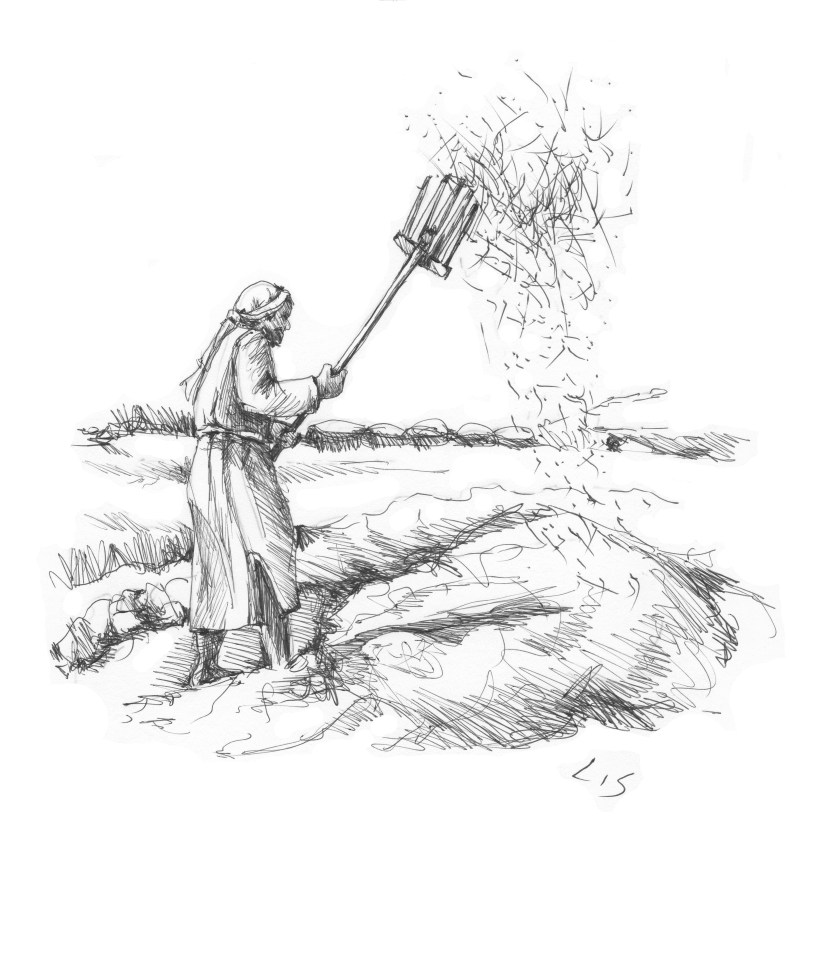
Chapter Nine
Spread Your Garment Over Me
Now for the answer to what has seemed a very questionable situation. When I acknowledged I was Boaz’s servant, I revealed my desire to be a part of his household. When I asked him to spread his garment over me, to cover me, I was asking him to become my lord and protector. It was a very bold move to make, but the meaning did not escape Boaz. I had just flat-out asked him to marry me.
Boaz as a kinsman-redeemer means he is my kin and has the right to redeem the family name. He agrees our firstborn son would be considered the son of my dead husband Mahlon. That son would inherit any land belonging to Mahlon and carry on his name.
The idea is to be able to redeem or get back something that would be lost. In my Old Testament story, Boaz is a figure or example of Jesus. We see in Boaz a picture of Jesus as our Kinsman-Redeemer. Jesus is the firstborn Son of God. He died on the cross in our place. His death provided a way to redeem us from the penalty of our sinful nature. This sinful nature causes separation from God for all eternity. Jesus as our Kinsman-Redeemer welcomes us into God’s family if we will call out to Him.
At Naomi’s bidding, I have put myself in a really weird situation. I have been very bold and daring asking for Boaz to marry me. Now let me show you how Boaz responds.
“Bless you, my daughter. This kindness is greater than any you have shown before. You have not run after younger men, whether rich or poor.”
What a revealing statement for Boaz to make. He is truly overcome by my marriage proposal. Boaz tells me not to be afraid adding,
“I will do for you all you ask.” Can I hear an amen? His heart is in tune with mine. Boaz has returned my profession of love by saying “I will.” I just about melt.
Boaz tells me that what I have just done is greater than any kindness I have shown him before. My head has not been turned by younger men. I desire him. Let me tell you, there is a lot of emotional stuff going on here.
Boaz wants to marry me, but there is a fly in the ointment. There is a closer relative who has the first right to marry me and raise up a son for my dead husband. Boaz tells me if the nearer kin wants to marry me, he has the right. But if he does not then Boaz certainly wants to.
Not wanting anything to happen to me walking home in the dark, Boaz tells me to remain until dawn. Before it is light enough for anyone to be recognized, he tells me to leave so no one will know I was on the threshing floor. Boaz is protecting me. Wow. He wants to keep my good name from any hint of scandal, so no tongues will wag. You can rest assured there was no funny stuff going on in the night.
Boaz asked for the shawl I was wearing.
“Hold it out in front of you,” he said and filled the shawl with grain. Then he sent me home. When I got to the door of the little hut, Nomi was waiting for me. She must have been sitting up all night, worrying. She was the one who sent me to the threshing floor, so Naomi was on pins and needles waiting to hear how her plan went.
“Tell me my daughter how did it go?” She asked anxiously.
I told my mother-in-law everything that had happened in the night. I showed Naomi my shawl filled with grain, adding excitedly, “Naomi, he is so wonderful. He remembered you, and said he didn’t want me to return to you empty-handed.” Naomi was pleased beyond measure and said joyously,
“Now just wait, my daughter, until you find out what happens.” Wait. Just what I didn’t want to hear. The most important thing in my life is hanging suspended in mid-air, and Naomi tells me to wait. Then Naomi says something that makes everything all right.
“The man will not be able to rest until the matter is settled today.” Boaz dearly loves me. And Naomi knows he will not be able to sit still until he has settled the matter this very day.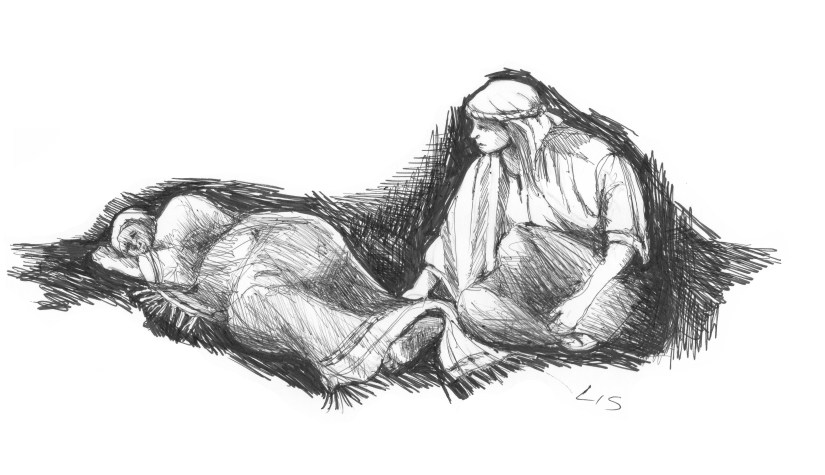
Chapter Ten
No Deal So and So
Boaz made straight for the town gate. The gate is a place of great importance in the life of the people of Judah. It is a meeting place and courtroom. There the elders and prominent men of the town gather to talk and hold court. It’s where they settle important legal and business matters. Ten elders are required to act as judges, and witnesses, to settle cases of marriage, divorce, and inheritance. For a man to have the honor of sitting in the gate means he is highly respected.
It was early morning, and people were making their way to the market in the center of town. Boaz took a seat at the entrance, watching the faces of the people passing by. Shortly, he saw the one he had been looking for. His relative, the nearer kin, who had the first right to marry me came strolling by. Boaz called to him saying,
“Come here and sit with me, my friend.” The kinsman came and sat down. Then Boaz called the ten elders and bid them to sit also.
Boaz had a plan. Watch as he presents his plan to the nearer kinsman. Talk about high drama. When the elders were seated, and a full court was established, Boaz spoke to his kinsman with the right to redeem,
“Naomi, who has just returned from Moab, is selling a piece of land that belonged to our brother, Elimelech. I immediately thought of you, and would like to suggest that you buy it. The elders are here so we can finalize the deal right now. If you want to redeem Naomi’s land, great, you are the one who has the first right to redeem it. But I am next in line, and if you don’t want to buy the land, I will.” Notice all Boaz is talking about is the land.
When Elimelech and Naomi left for Moab because of famine in the land of Israel, Elimelech did not sell his property before he left. He was still a landowner in Judah. In a masterful move, Boaz has informed the closer relative that Naomi, in her poverty, wishes to sell the land belonging to her dead husband. But Boaz has not said anything about me. At this point, the kin is only aware of the offer to buy land. In his desire to increase his holdings, the kin says he will buy Naomi’s piece of property. Boaz is brilliantly setting up this whole scenario to have it go the way he wants it to go. He is holding a trump card and is about to play it.
When the nearer kin said he would buy the land, Boaz adds, “On the day you buy the land from Naomi, and from Ruth, the Moabitess, you have to marry the widow. You must continue the name and property of Ruth’s dead husband.” Boaz has just added a second part to the sale of the land. The property belonged to Naomi’s husband, Elimelech. Upon his death, the land was transferred to his eldest son, Mahlon, my deceased husband. The kinsman-redeemer now finds he can’t have the land without marrying me. You might say, the land goes with the hand. The disappointed nearer kin now states,
“I can’t redeem the land if I must marry Ruth also. It might endanger my own estate. You redeem it, I cannot.” You see the nearer kin was already married, and he did not want to put the future of his kids in jeopardy.
This is just the answer Boaz was hoping to hear. His plan worked. By refusing to marry me along with buying the land, the nearer kin had put himself out of the picture. Now Boaz became the near kin and stepped into the role of kinsman-redeemer.
Jewish tradition says that by refusing to marry me, the nearer kin became referred to as So and So. In other words, he was a John Doe. The townsfolk said,
“We choose not to remember his name.” And in time So and So’s name actually did become forgotten.
Chapter Eleven
Giving Up the Shoe
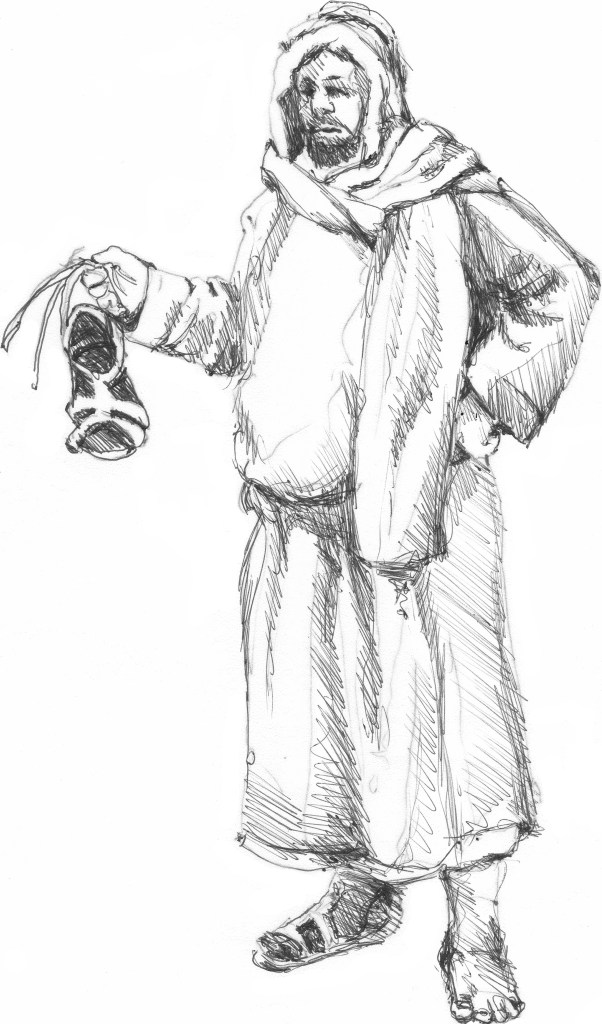
At this point in my story, we are introduced to one of those interesting old Hebrew customs. The curious case of the shoe. Remember the Leverite Marriage Law? It was the legal basis for raising up a son for the dead. There is a second part to that law that states: However, if the near kin does not want to marry the dead relative’s widow. She has the right to go to the elders, who summon the near kin to the town gate. If he is still unwilling to marry, he removes his shoe and gives it to the other party. This becomes an act of finalizing the transaction.
This is exactly what happened in my story. So and So gave up his shoe, and was legally out of the picture. He had just made the wrong choice and passed up the chance to have his name preserved in history. So and So would not marry me because it might cause a problem for his descendants. But Boaz and my marriage led to the royal line of King David, and on down through time to King Jesus.
We clearly see God’s hand in this. Boaz has been His choice for kinsman-redeemer all the time. This is such a beautiful picture of Jesus as our Kinsman-Redeemer. The perfect Son of God purchased our right to be included in the Lord’s Family.
Boaz is now the kinsman-redeemer with the right to buy the field and claim my hand. This is the high point in my story, love winning overall. Movie plots today don’t get any better. We have had exile, loss of loved ones, riches to rags, return home, unexpected generosity, discovery of family, developing love, legal stumbling blocks, and love triumphing. What drama. With the legal matter of who was to be the near kin out of the way, Boaz and I are now able to marry and live life as God intended us to.
Imagine Boaz standing there holding So and So’s shoe in his hand. Saying to the elders,
“You are my witnesses. Today I have bought from Naomi the property belonging to Elimelech and his sons. I have also acquired the hand of Ruth the Moabitess, the widow of Mahlon, to be my wife. The name of her dead husband and his property will not disappear from the town records, but will pass from this generation to the next.” Then Boaz raising his hand holding the shoe shouted, “You are my witnesses!”
Naomi and I were standing quietly at the side of the gate. I held Naomi’s hand tightly waiting for the verdict. The elders and bystanders answered Boaz in one happy voice.
“We are witnesses.” With a sigh of relief, Naomi gave me a joyous hug. Tears were streaming down my face as I kissed Naomi on the cheek. Mama’s plan had worked. Boaz’s plan had worked. Unshakable friendship had overcome desperate odds.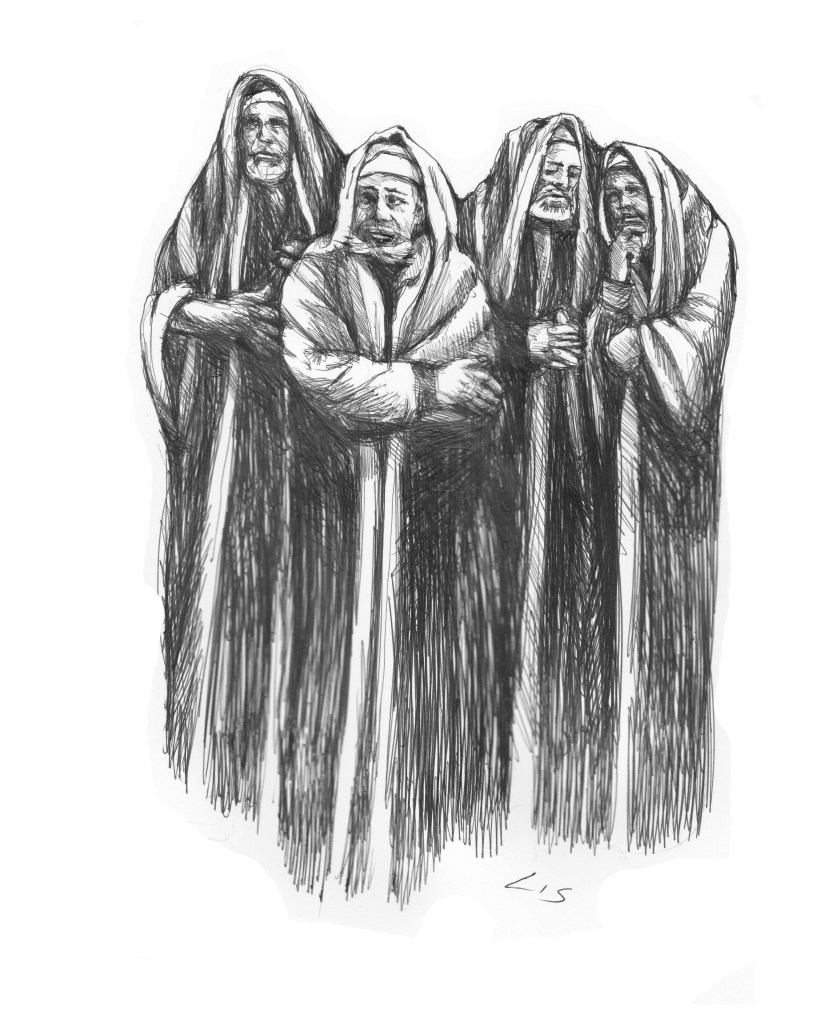
Chapter Twelve
The Blessing, The Marriage, The Son
Then the elders and towns folk gave us a prayer of blessing. “May you be well-known and have standing in Bethlehem. May the Lord make you, Ruth, like Leah and Rachel who built up the house of Israel. Through the offspring the Lord gives you may your family be like that of Perez.”
What a wonderful prophetic blessing for us. The people had seen me, the Moabitess, day after day. I was from a foreign land. They had not wanted to like me, but they saw what a devoted friend I was to Naomi. Most importantly they saw I had made the God of Israel my Lord.
Leah, Rachel, and their hand-maidens were the mothers of the Patriarchs, Abraham’s sons. They made up the 12 tribes of Israel from Ruben to Benjamin. Every Hebrew born was from one of these 12 families. Judah was the fourth son born to Abraham. Perez was the son born of the questionable union of Judah and Tamar, Judah’s daughter-in-law. Just as in my story, it looked as if the name of Judah would be lost. There was no son to carry on the family name until Perez was born. The importance of this is huge when we learn that Elimelech, his son Mahlon, and his near kinsman, Boaz are descended from Perez.
In the book of Genesis, or Beginnings, the Lord spoke to Abraham and said He would make him the father of many nations. When Abraham was an old man he called his 12 sons together to prophesy about their descendants. Of Judah, he said, “The royal staff will not depart from the family of Judah until Shiloh comes.” Shiloh was an Old Testament term for Jesus. God told Abraham that kings would come from his family. In the fullness of time, Judah’s family included the King of Kings, Jesus.
Boaz and I soon married, and the Lord blessed us with a son. Naomi’s friends were joyful at the events that had taken place in her life. They prayed a blessing on our family in their rejoicing, “Praise the Lord who has not left you without a kinsman-redeemer. You went away full, but came back empty. You said to call you bitter. You had no husband or sons to carry on the family name. No grandchildren to cling to your skirts.
But the Lord has looked with compassion on your impossible situation. And your daughter-in-law, a foreign woman, has captured the heart of Boaz. The Lord sent him to redeem your name. And now a son has been born into your family. May your grandchild become famous throughout Israel.” The ladies also proclaimed that Naomi’s grandchild would renew her interest in life, and would take care of her when she was old.
Then they add this stunning tribute to me, “Your daughter-in-law, who loves you and is better to you than seven sons, has given birth to this boy.” Remember, I am a foreigner. What a name I have had to overcome, ‘the Moabitess’. The women of the town were skeptical of me at the beginning. But they saw my devotion to my best friend, Naomi. And it changed whatever prejudices they might have had toward me.
“You are better than seven sons.” What a compliment. Sons we have learned were of supreme importance to Hebrew women. And they have just placed me above seven of them. They know I love Naomi, my dear friend, and that my son will love her also. He is my son, so how could he be any different?
The fulfillment Naomi must have felt as she held my baby boy close to her. She loved and cared deeply for her grandson. And had a large part in bringing him up in the fear and admonition of the Lord. She was his grandma after all. Finally, the ladies named my son, Obed, which means serving. And without a doubt, he took very good care of his Granma Naomi.
Our story ends with a list of names of the descendants from Perez, born to Judah and Tamar, to Boaz and me, and our son Obed. And concludes with the names: Obed the father of Jesse, and Jesse the father of David. Imagine King David, the greatest king in all of Old Testament history is Obed’s grandson. But wait there is one more really great thing to discover.
To find it we turn to the first book of the New Testament, to the Book of Mathew. In the very first chapter, in the very first verse, we find a list of names. It is a record of the genealogy of Jesus Christ. Starting with father Abraham, we go to his son Isaac, and his son Jacob, down to Judah and his son Perez. Eventually to Boaz and his son Obed, to Jesse and his son King David. On down through history until we find the name of Joseph, the husband of Mary, the mother of Jesus.
This was God’s plan all along. From Father Abraham to Jesus, the savior of all mankind. What a family tree we are a part of. Boaz and I, from the little town of Bethlehem, to baby Jesus born in a manger in that same little town thousands of years later.
In my story, we see what God can accomplish through one woman devoted to Him. Though I was a foreigner, the Lord chose me, just as he chose Mary, to be the one through whom Jesus would come – Jesus, our Kinsman-Redeemer, and best friend forever.
END
DISCOVERY CHALLENGE
CHOICES
But if serving the Lord seems undesirable to you, then choose for yourselves this day whom you will serve, whether the gods your forefathers served beyond the River, or the gods of the Amorites, in whose land you are living. But as for me and my household, we will serve the Lord.
Joshua 24:14,15
Both Naomi’s daughters-in-law wept when Naomi told them to leave her and return to their families. Lord knew what was on the heart of each woman. He knew which daughter would follow Him with all her heart.
Orpah might have been willing to give up her family, her friends, and her country, but would she give up her gods? The things that came first in her life. When faced with a difficult challenge, Orpah chose to return to her old life and ways.
We see the difference between Orpah and Ruth. Orpah turned back, but Ruth clung to Naomi and would not leave her. What she saw in Naomi caused Ruth to choose to go with her, even though it must have looked like a dead-end path. The life ahead in Judah must not have been appealing to Ruth. How easy it would be to stay where she was and just let life flow on as before. But Ruth chose to follow Naomi and Naomi’s Lord. It so happened that Ruth’s choice had a lasting impact on the rest of history.
Sometimes the decision to go with God seems to be the most difficult. The Lord puts circumstances in our lives that cause us to have to decide if we are going to follow Him or remain in our settled ways and miss the blessing He has for us.
TESTING
O Lord, do not rebuke me in your anger or discipline me in your wrath. For your arrows have pierced me, and your hand has come down upon me.
Psalms 38:1,2
Naomi was heavy in heart. Even though her name meant pleasant, she told her friends to call her bitter because she had lost everything. This was a time of great testing for Naomi.
Let’s look at another group God tested. Moses and the Children of Israel wandered in the desert without water. After three days in the hot desert, they finally found water, but it was undrinkable. Then the Lord gave them a miracle. He made the bitter water sweet to their taste. If that was not enough, the next day they picked up and traveled to their next stop – Elim where there were 12 springs of water and 70 palm trees. An oasis where they rested and were refreshed.
Naomi recognized the hand of the Lord had brought her to this state. She said:
“The Lord has made my life very bitter. The Lord has brought me back empty. The Lord has afflicted me and the Lord has brought misfortune upon me.”
Naomi had endured great loss. Now she was returning home in shame, certain the Lord had dealt harshly with her.
Lord was proving Naomi in this bitter trial. He knew her strength and her character. And He was about to reveal more of Himself and the goodness of life than she had ever dreamed.
When the Lord asks us to do something out of our comfort zone, we can rely on Him to bring us through. The Lord leads us and reveals more of Himself through our experience.
OBEDIENCE
Walk in obedience to all that the Lord your God has commanded you, so that you may live and prosper and prolong your days in the land that you will possess.
Deuteronomy 5:33
Obedience is one of my more difficult words. I don’t always want to be obedient. I want to do things my way. But then I think what a mess I would make if I had only to depend on myself.
Obedience is choosing to do God’s will. It is a major concept in the Book of Ruth. In Chapter 3, Naomi tells Ruth to go to the threshing floor, find where Boaz is lying, and lie down at his feet. So, Ruth does exactly as Naomi has suggested.
To our eyes, Naomi’s request seems very strange, to say the least. But it is Ruth’s unquestioning willingness to do as her mother-in-law suggests that is the heart of our story. This obedience is born of trust. Ruth has learned that Naomi’s instructions are true and God-centered.
When Jesus asks us to do something beyond what we think we are capable of, we are inclined to answer – ‘you’ve got to be kidding. However, obedience is learning to walk in faith knowing that His will is right for us. If we can do it ourselves it is not faith. Only when we rely on Jesus and step out to do whatever He is asking us, will we learn to trust Him.
TRUST
“But I trust in Your unfailing love; my heart rejoices in Your salvation.
Psalm 13:5
Ruth placed herself in a position of trust with Boaz. First, she trusted in the safety of gleaning in his fields unharmed. Then she came to know Boaz as a kind man who was concerned for her and her mother-in-law.
So, at the threshing floor when she asked Boaz to cover her with the corner of his garment, Ruth was placing her ultimate trust in him. She believed he would care for her and her family forever.
We come to trust the Lord because of His complete love for us. He is always there. He will never abandon us. We can rest in that truth no matter what is happening around us. Psalm 36:7 best describes this feeling of trusting the Lord’s protection.
FAVOR
When you are harvesting in your field and you overlook a sheaf, do not go back to get it. Leave it for the alien, the fatherless and the widow, so that the Lord your God may bless you in all the work of your hands.
Deuteronomy 24:19,20
In this beautiful Levitical Law God commands us to show kindness to the poor and stranger in our midst. His concern for the less fortunate among us is very evident. If we will just look, we will see His hand of Providence everywhere.
In our story, we immediately see Boaz’s kindness. He tells his workers to leave grain for this Moabite woman. He positions himself as her protector, warning Ruth not to go into another field where she might not fare so well.
Boaz favored Ruth before she was even aware of his existence, just as Jesus first calls us. Ruth was in a state of poverty when Boaz had favor on her. God’s grace is similarly bestowed on us who are lost in the poverty of sin. All we can do is fall at His feet and ask, as Ruth asked of Boaz, “Why have I found such favor in Your eyes?”
Finally, Boaz encourages Ruth to drink from the water jars when she is thirsty.
Jesus answered, “Everyone who drinks this water will be thirsty again, but whoever drinks the water I give him will never thirst. Indeed, the water I give him will become in him a spring of water welling up to eternal life.”
John 4:13,14
Jesus is speaking to the Samaritan woman at the well. He declares he will give living water to all who are thirsty. What a beautiful symbol of the Holy Spirit and Salvation, freely outpoured to whoever desires it.
COVER
He will cover you with His feathers, and under His wings you will find refuge;
Psalms 91:4a
At the threshing floor that night, Ruth asked Boaz to spread a corner of his garment over her. We know what Ruth is really asking Boaz to agree to be her lord and protector. Covering her with his robe would be the sign that Boaz accepted Ruth forever.
What a beautiful picture. Being safe under the outstretched arms of our Lord, as a mother hen spreads out her wings over her gathered chicks to keep them safe.
Imagine God sheltering you with His protection. He is holding you close and wrapping you in His love so that nothing can harm you.
VIRTUE
A wife of noble character who can find? She is worth far more than rubies. Her husband has full confidence in her and lacks nothing of value. She brings him good, not harm, all the days of her life.
Proverbs 31:10-12
This description of a woman of virtue from the Old Testament is worth reading. Let’s look at a few more verses of the proverb that give us the guidelines for a woman of positive moral character:
She is clothed with strength and dignity; she can laugh at the days to come. She speaks with wisdom, and faithful instruction is on her tongue. She watches over the affairs of the household and does not eat the bread of idleness. Her children arise and call her blessed; her husband also, and he praises her. Many women do noble things, but you surpass them all. Charm is deceptive, and beauty is fleeting, but a woman who fears the Lord is to be praised. Give her the reward she has earned, and let her works bring her praise at the city gate.
Proverbs 31:25-31
Boaz checked out Ruth’s background and found her to be a woman of noble character. How would we define being a woman of virtue today? Have the guidelines changed from Ruth’s day? Is there really anything new under the sun?
SUBSTITUTION
God’s way to remove our sin is by substitution and sacrifice. We are separated from our Heavenly Father because our sinful nature cannot exist with His holiness. Therefore, God designed a way of redeeming sinful man. Under the Old Testament Law, an animal was sacrificed in place of the person and his sin transferred to that animal. The animal died, not the person.
A beautiful example of this sacrifice and substitution is seen in the Old Testament account of Abraham and Isaac. The Lord told Abraham to sacrifice his son, Isaac. The son through whom the Lord had promised Abraham his descendants would be as many as the stars in the sky. Abraham trusted the Lord, and God provided a ram as a substitution for the life of Isaac.
Gen 22:1:19
Jesus, became my substitute and died in exchange for my life. But why? Why did Jesus die for me? Because He loves me.
REFUSAL
However, if a man does not want to marry his brother’s wife, she shall go to the elders at the town gate and say, “My husband’s brother refuses to carry on his brother’s name in Israel. He will not fulfill the duty of a brother-in-law to me.” Then the elders of his town shall summon him and talk to him. If he persists in saying, “I do not want to marry her,” His brother’s widow shall go up to him in the presence of the elders, take off one of his sandals, spit on his face and say, “This is what is done to the man who will not build up his brother’s family line.” That man’s line shall be known in Israel as The Family of the Unsandaled.
Deuteronomy 25:5-10
The nearer kinsman would not redeem the land when he found marriage to Ruth went with the purchase. According to Josephus, a first-century historian, the nearer kin was already married. He did not want to put the future of his offspring in jeopardy.
Because So and So would not marry Ruth, his name eventually became forgotten and left out of history. What an interesting turn. Through the marriage of Ruth and Boaz came the royal line of King David and Lord Jesus. So and So made the wrong choice and passed up his chance to have his name preserved for all time.
CHOSEN
In Him we were also chosen, having been predestined according to the plan of Him who works out everything in conformity with the purpose of His will,
Ephesians 1:11
Boaz announced to the elders and all the people that he had chosen Ruth to be his wife. He also bought from Naomi all her property. He has acquired it all, nothing is left out.
What a beautiful picture of Christ redeeming his bride, the Church. We are purchased by Jesus’ death on Calvary, and He has clothed us in His righteousness. That means we are we are accepted by the Lord.
The Lord chose Ruth, just as He chose Mary, to be the one through whom Jesus would come. We are kings and priests. One day we shall reign with Jesus on the earth. Wow, talk about a royal family. Interestingly, this bible passage is in the past tense. It has already been done. We do not yet see it, but in the mind of God, it is accomplished.
BLESSING
I will show my love to the one I called ‘Not my loved one.’ I will say to those called Not my people, ‘You are my people;’ and they will say, ‘You are my God.’
Hosea 2:23b-c
Our story of Ruth concludes with the family genealogy from Obed, the son of Ruth and Boaz, to Obed’s son Jessie, and grandson King David.
God intended that through one gentile woman, yielded to Him, the line of the Messiah would continue from the Garden of Eden, through Abraham, Isaac, and Jacob to King David. Ultimately traveling through time to Lord Jesus, the fulfillment of all the ages. Through whom God reconciled us to Himself.
The Lord, in His mercy, has called both Jew and Gentile to Himself. In the story of Ruth, we see what God can accomplish through the obedience of one woman. Ruth was an outsider, a Gentile in a Jewish nation. Yet by Jew and Gentile, Boaz and Ruth, the Sovereign Lord brought forth Jesus our King of Kings and Lord of Lords.
FAMILY
For God so loved the world that He gave His one and only Son. That whoever believes in Him shall not perish but have eternal life.
John 3:16
Family. People of like mind. We have seen how important family is to the ancient Israelis. This love of family is the pivotal point of the whole book of Ruth, a kinsman’s right to redeem something that would be lost.
In the case of Ruth, the line of Elimelech must be redeemed so that his heirs may continue. And that future generations may have an inheritance in the land.
In the person of Boaz, we see a picture of Jesus, the firstborn Son of God, redeeming His Church. Jesus gave Himself a ransom for us so that we might be called the children of God. We are kin. Jesus is our older brother.
He has exercised the right of the Kinsman Redeemer by His death on Calvary and provided for us an eternal inheritance in heaven. Just look at the scriptures including us, the redeemed, in God’s family:
For those God foreknew he also predestined to be conformed to the likeness of his Son, that He might be the firstborn among many brothers.
Romans 8:29
But when the set time had fully come, God sent his Son, born of a woman, born under law, to redeem those under law, that we might receive adoption to sonship.
Galatians 4:4,5
So, you are no longer a slave, but God’s child, and since you are His child, God has made you also an heir.
Galatians 4:7
How great is the love the Father has lavished on us, that we should be called the children of God!
1 John 3:1
Now if we are children, then we are heirs – heirs of God and co-heirs with Christ, if indeed we share in his sufferings in order that we may also share in his glory.
Romans 8:17
You are all sons of God through faith in Christ Jesus, for all of you who were baptized into Christ have clothed yourselves with Christ.
Galatians 3:26
Jesus our kinsman redeemer, our legally qualified near kin, is able to redeem us from death to everlasting life. We are all under the curse of death because of Adam’s fall in the Garden of Eden and our own personal sin nature. Jesus the firstborn of the Father was raised up so that we who were dead in sin would not perish.
This is the best news ever. We can spend eternity with Jesus. If you would like to receive Jesus as your Savior and Lord, to be a part of His family forever simply say this prayer:
“Jesus, I know you died for my sins. I don’t want to live my old life anymore. Please come into my heart. Save me and make me a new person. I make the You Savior and Lord of my life. In Jesus’ Name I pray. Amen.”
It is not the particular words of this prayer that are important, it is what believe in your heart. The Bible quote below says it best:
If you declare with your mouth, “Jesus is Lord,” and believe in your heart that God raised Him from the dead, you will be saved.
Romans 10;9
If you prayed this prayer, may the Lord bless you richly. Learn about this wonderful Jesus, by reading His love letter to us, the Bible. And find a Bible-believing church where you can meet fellow Christians and grow in the Lord. You have just received the best takeaway my book offers – Jesus.

